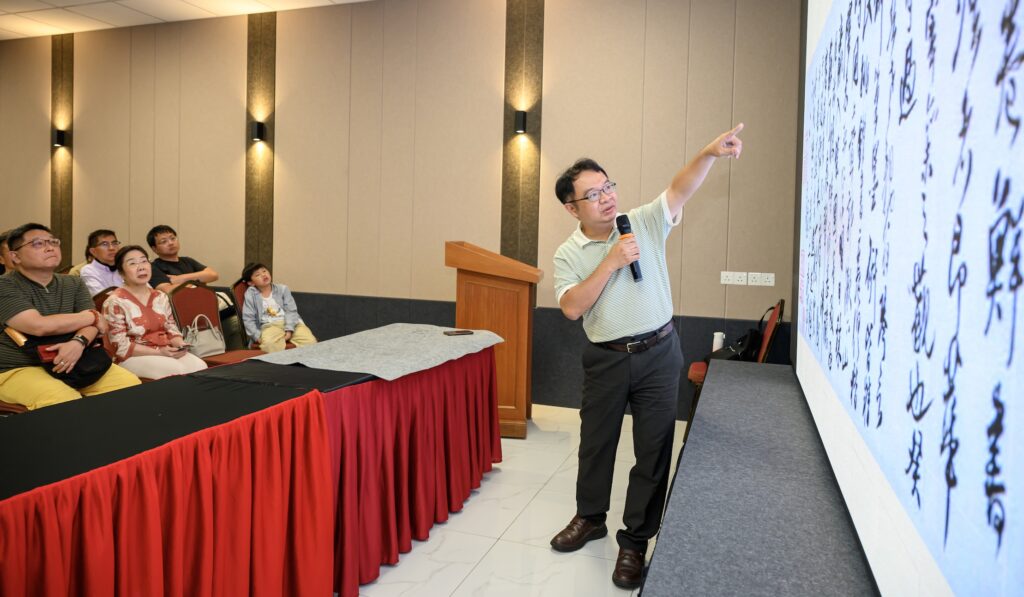


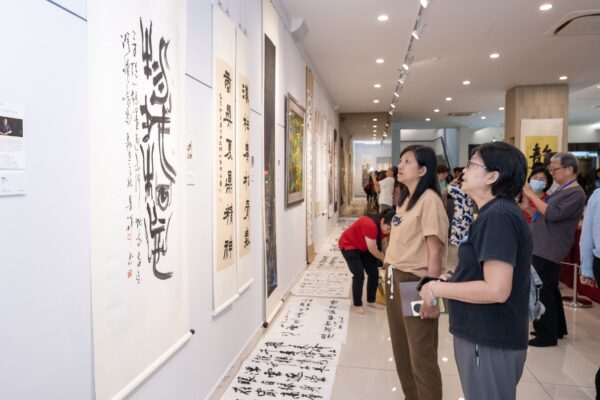
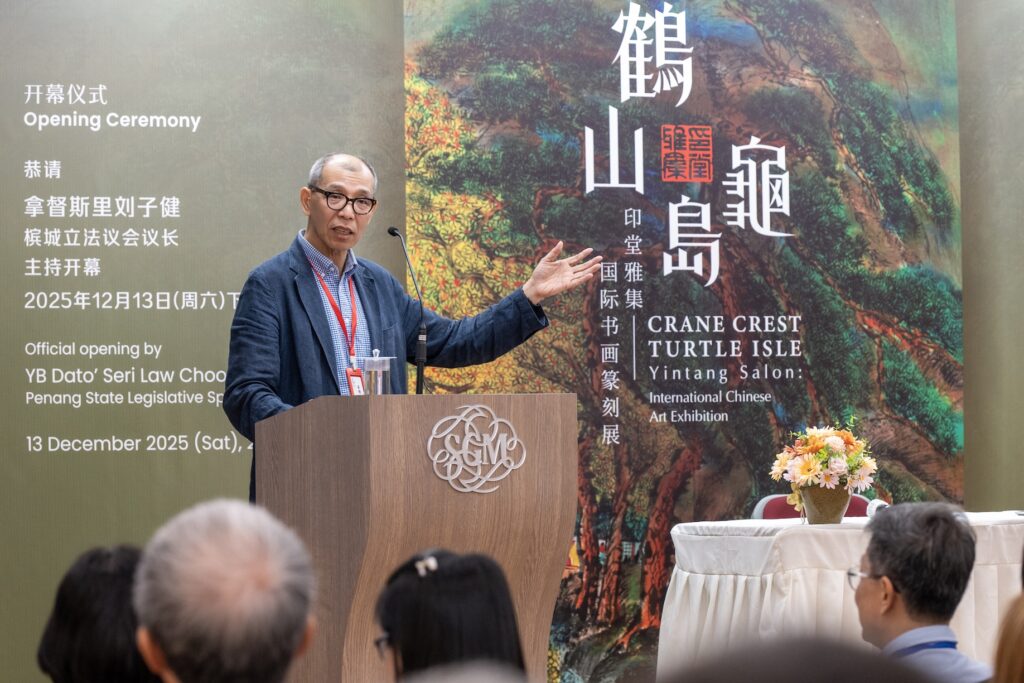
The “Crane Crest, Turtle Isle – Yin Tang Salon: International Chinese Art Exhibition” was held from 13–28 December 2025 at the SGM Penang Culture Centre, attracting nearly 2,000 visitors.
 |
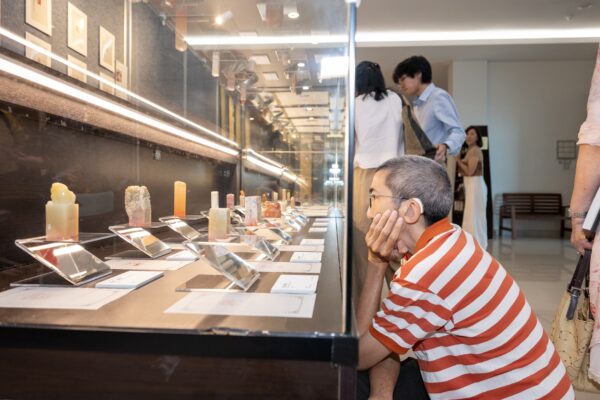 |
The exhibition featured works by 44 artists from China, Hong Kong, Japan, Malaysia, Singapore, Taiwan and the US, showcasing calligraphy, traditional painting, ink wash painting and seal carving. It was jointly organised by SGM Penang and Shanghai Boyintang, with the Calligrapher’s Association of Penang and Guangdong Yaqing Culture Co., Ltd. as coorganisers.
The opening ceremony, on 13 December, was officiated by Penang State Legislative Assembly speaker YB Dato’ Seri Law Choo Kiang, who emphasised that art is a core force driving urban development. He expressed hope for more joint exhibitions, artist residencies and art education collaborations, allowing art to become more deeply integrated into the community.
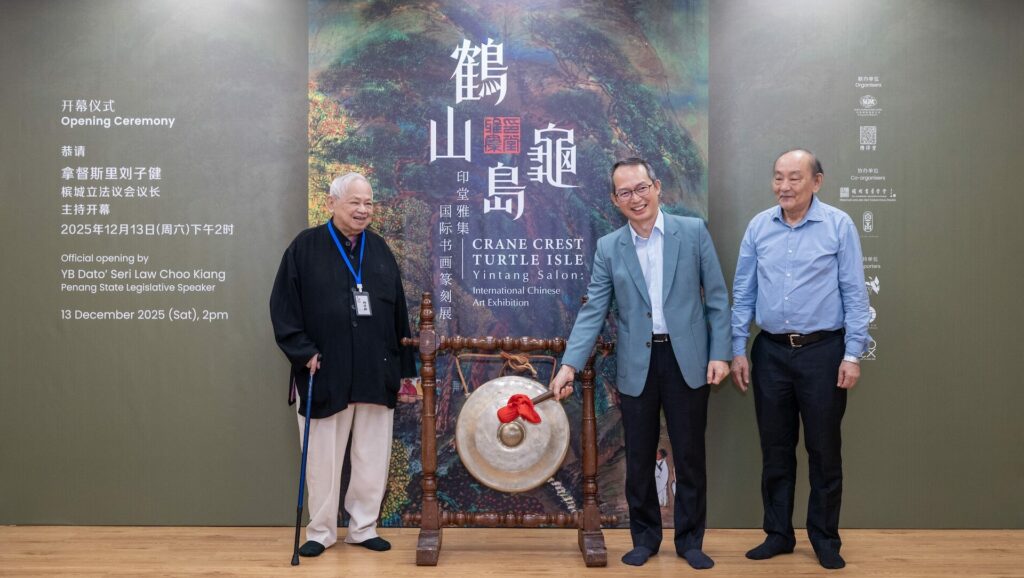
SGM General Director Koh Sia Feai highlighted the power of art and culture to nurture the soul and connect hearts, fostering dialogue and resonance.
Yin Tang Salon founder Dr Sesin Jong expressed gratitude for Penang’s warm hospitality and shared his hope for the continued flourishing of cultural exchange in the future.
Renowned international cultural figure Chen Hsiao-Chun explained the symbolism behind the exhibition’s title, noting that “Turtle Isle” – a reference to Penang – symbolises stability and longevity, while the crane represents nobility and longevity.
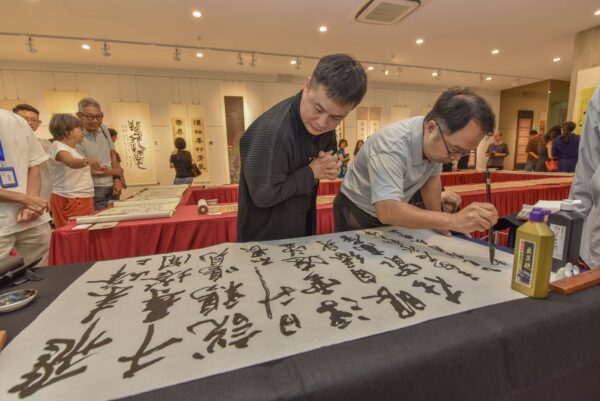
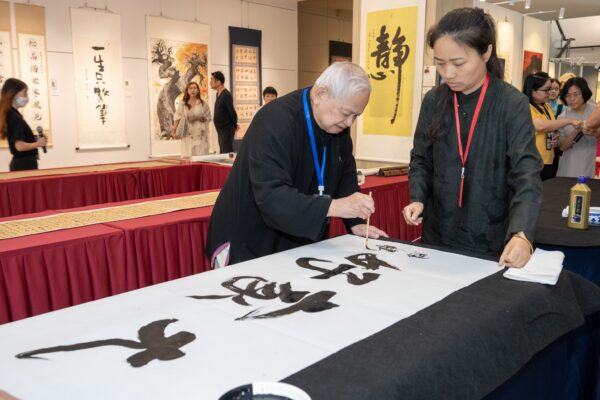
Following the ceremony, 10 artists presented a live calligraphy demonstration, captivating audiences with their expressive brushwork. The performance drew a large crowd and sparked enthusiastic exchanges.
 |
 |
Art Talks
To complement the exhibition, three art talks were held at the SGM Penang Culture Centre on 13 and 14 December, followed by another session on 15 December at the Penang Philomathic Union Sun Yat-Sen Centre.
On 13 December, National Taiwan University of Science and Technology Adjunct Professor Tsai Yao-Ching explored the evolution of seal carving, detailing the transition of this art form from a practical tool to an independent aesthetic discipline.
The following day, Chinese art connoisseur Hu Xilin provided an in-depth exploration of works by Lan Ying, a renowned Ming dynasty landscape painter, guiding the audience through the artist’s distinctive style.
Also on 14 December, Fung Yat-fung, a Hong Kong-based expert in Chinese painting mounting, restoration and the replication of Tang- and Song-dynasty papers, delivered a lecture on traditional paper-making techniques from the Tang and Song dynasties.
On 15 December, Ho Chuang-shih Calligraphy Art Foundation director and chief research fellow Dr Wu Guo-Hao shared insights into how the renowned calligrapher Wang Duo employed calligraphy as a means of communication and social interaction.