“Crane Crest, Turtle Isle – Yin Tang Salon: International Chinese Art Exhibition” Gathers 44 International Brush and Ink Artists
The “Crane Crest, Turtle Isle – Yin Tang Salon: International Chinese Art Exhibition” opened on 13 December 2025 at the SGM Penang Culture Centre. This exhibition, which ran till 28 December, was jointly organised by SGM Penang and Shanghai Boyintang, with the Calligraphers Association of Penang and Guangdong Yaqing Culture Co., Ltd. as co-organisers. A total of 1,985 visitors graced the exhibition, which received praise from the public.
Bringing together 44 artists from China, the United States, Japan, Singapore, Malaysia, Taiwan and Hong Kong, the exhibition showcased works in calligraphy, traditional painting, ink wash and seal-carving rich in diverse artistic styles and traditional roots. The rich artistic atmosphere exuded cultural warmth and profound emotional resonance.
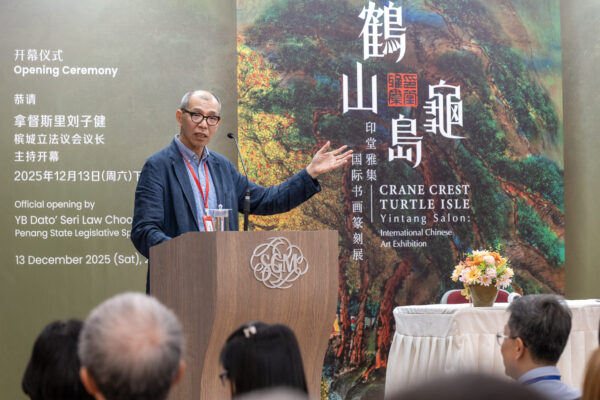
In his opening remarks, SGM General Director Koh Sia Feai stated that art and culture possess the power to nurture the soul and connect hearts, fostering dialogue and resonance. Yintang Salon founder Dr Sesin Jong quoted the Analects: “Is it not a delight to have friends coming from afar?” to express his gratitude for Penang’s warm hospitality, adding his wish for the continued flourish of cultural exchange in the coming year.
Renowned international cultural figure Chen Hsiao-chun noted that this gathering was not merely an exhibition, but an awakening and continuation of cultural memory, bringing warmth to Chinese culture worldwide. She further interpreted the exhibition title, explaining that “Turtle Isle” (referring to Penang) symbolises stability and longevity, while the crane represents nobility and longevity. Hu Xilin, representing Yintang Salon, recounted the group’s 13-year history and its 12 major events, noting that despite the pause caused by the pandemic, they have continued to move forward. He welcomed feedback from all sectors and solemnly pledged that they will definitely return in the future.
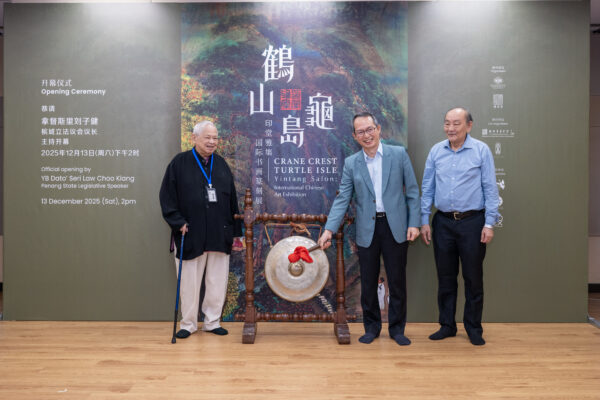
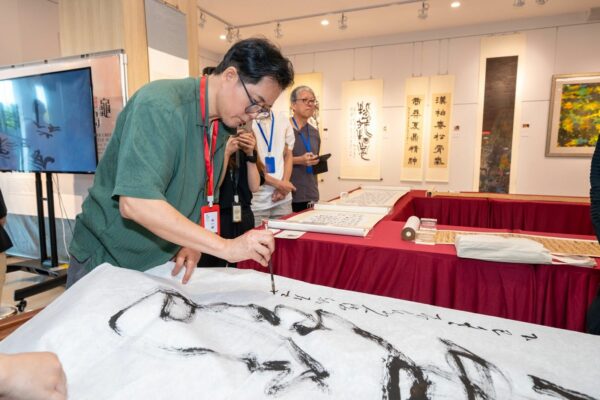
Penang State Legislative Assembly speaker YB Dato’ Seri Law Choo Kiang officiated the opening ceremony. He pointed out that art is a core force driving urban development and expressed his hope for more joint exhibitions, artist residencies, and art education collaborations to allow art to truly integrate into the community and daily life. Following the ceremony, ten artists performed live calligraphy. Their vivid brushwork and profound artistic spirit created a traditional “literati gathering” (ya ji) atmosphere, drawing a large crowd for enthusiastic exchange.
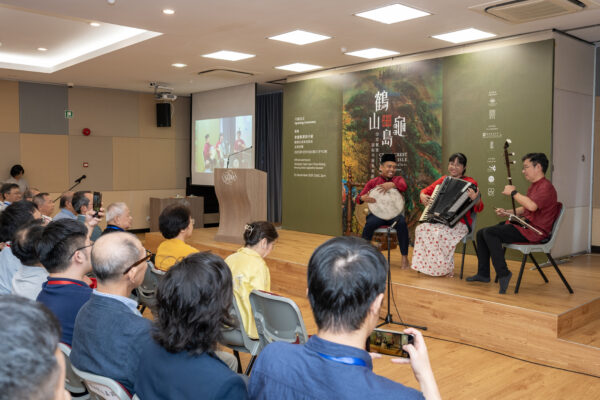
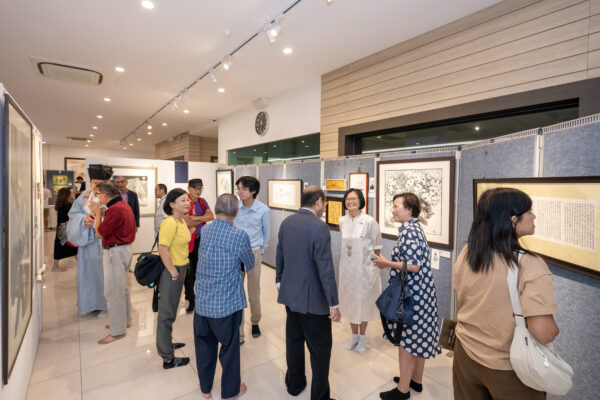
YB Dato’ Seri Law Choo Kiang striking the gong to officiate the opening of the “Crane Crest, Turtle Isle – Yin Tang Salon: International Chinese Art Exhibition.” To his right is Yintang Salon founder Dr Sesin Jong.The Gentarama indigenous ensemble performing Aladom and Nona Zaman Sekarang + Trek Tek Tek medley, adding a vibrant and festive atmosphere to the opening ceremony.Artist Fung Yat Fung inscribing calligraphy live, his fluid and seamless brushwork drawing the admiration of guests who paused to watch.Guests arriving in a steady stream to view the works and interact with the artists, creating a warm and lively atmosphere throughout the venue.
“Searching Artistic Links for Seal Carving” – Exploring the Aesthetic Beauty and Cultural Significance of the Blade
On 13 December, National Taiwan University of Science and Technology Adjunct Professor Tsai Yao Ching hosted an art talk titled “Searching Artistic Links for Seal Carving”. The talk traced the evolution of seals from ancient official stamps to the seal carving of the Qing Dynasty, guiding the audience through the transition of this art form from a practical utility to an independent aesthetic discipline.
Professor Tsai pointed out that early seals were primarily used as symbols of status and for trade authentication. He highlighted that Qin Dynasty seals were noted for their “internal white borders,” while Han Dynasty seals saw the development of casting techniques and the “full white script” layout. As seals entered the civilian sphere and the practice of applying collectors’ seals to artworks grew, their usage continued to expand.
The art talk further explored the historical progression from Zhao Mengfu’s systematic research into seal history during the Yuan Dynasty, as well as the Ming Dynasty’s Wen Peng and He Zhen who proposed “Seeking Inspiration within the Seal.” This evolved into the higher realm of the Qing Dynasty’s philosophy of “Seeking Inspiration Beyond the Seal”, which emphasises the fusion of calligraphic mastery, blade technique and cultural depth. He encouraged seal carving practitioners to continuously refine their skills and realise the great potential within this traditional art form.
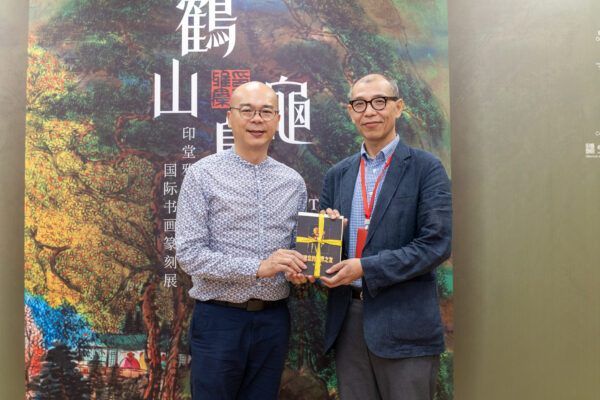
Professor Tsai presides over the art talk “Searching Artistic Links for Seal Carving”, providing an in-depth analysis of the development and aesthetics of seal carving to an attentive audience.SGM vice General Director Chia Kok Peng presents a memento to Professor Tsai, symbolising the bond of friendship forged through the arts.
“Reading and Appreciating Paintings: Reflections on Lan Ying” – Rediscovering the Innovator of the Ming Dynasty Art Scene
On 14 December, Chinese art connoisseur Hu Xilin hosted an art talk titled “Reading and Appreciating Paintings: Reflections on Lan Ying”. The art talk guided the audience through art history and representative works to rediscover the artistic style and historical significance of the Ming Dynasty landscape painter, Lan Ying.
Mr Hu noted that although Lan Ying came from a humble background and lacked formal education, he distinguished himself through his remarkable memory and diligent imitation of classic works. His talent eventually earned him the mentorship of renowned scholars such as Sun Kehong, Dong Qichang, and Chen Jiru.
Having travelled extensively across China, Lan Ying’s landscapes were largely inspired by his journeys throughout the Jiangnan region. His late-period works, such as White Clouds and Red Trees, demonstrate a bold use of colour and a surprisingly modern aesthetic.
Mr Hu argued that Lan Ying broke through the brushwork techniques of his predecessors with an avant-garde style. However, due to the relatively weak influence of the Wulin School of Painting and a lack of historical records, his contributions remained undervalued for a long period. He concluded that Lan Ying’s legacy deserves a fresh perspective and greater recognition from future generations.
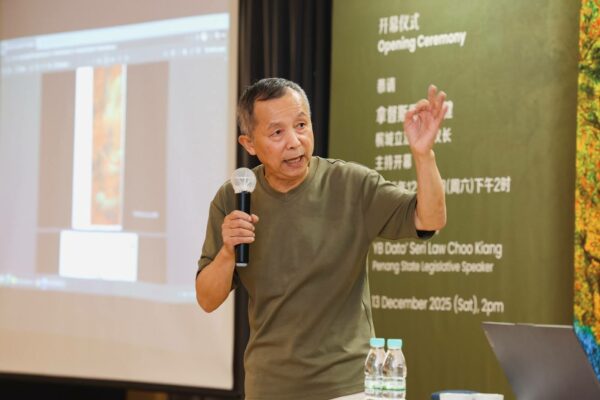
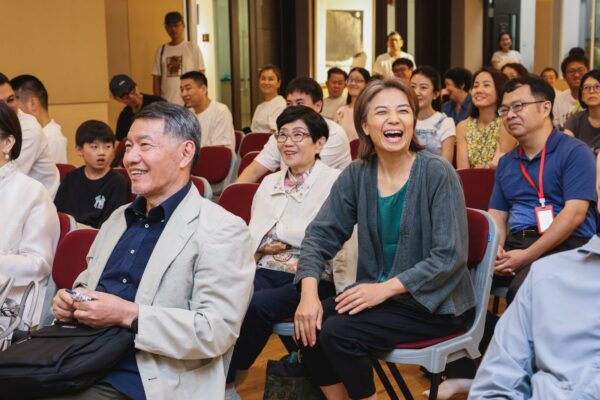
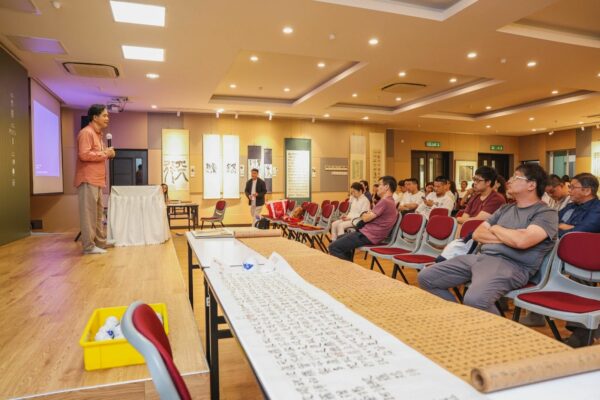
Hu Xilin explains key milestones in art history in an accessible manner, followed by an interactive question-and-answer session with the audience.The art talk enjoys a vibrant atmosphere filled with laughter, as the audience listens intently and engages in spirited dialogue.
“Research on Tang-style Paper and Song-dynasty Paper” – A Millennium on Paper: An Aesthetic Journey through Craft, Identification and Conservation
On 14 December, Fung Yat Fung, a Hong Kong-based expert in Chinese painting mounting, restoration and the replication of Tang and Song dynasty papers, delivered a lecture titled “Research on Tang-style Paper and Song-dynasty Paper”. The session provided an in-depth analysis of the technical characteristics and identification methods of ancient papers.
Mr Fung began by discussing the “period characteristics of paper”, detailing the distinct differences between Tang and Song papers in terms of fibre raw materials, laid lines and watermarks, the application of size and alum, and dyeing techniques. He shared professional methods for determining production techniques and periods by examining paper colour, texture and signs of ageing.
Drawing on his extensive experience in mounting and restoration, Mr Fung cautioned collectors to be prudent with cleaning and sizing methods to avoid damaging the original properties of the paper or the ink.
The lecture sparked lively discussion, with attendees raising questions on topics such as the identification and preservation of ancient paper, the layers of mounting and environmental climate control, further deepening their understanding of traditional papermaking and the conservation of calligraphy and painting.
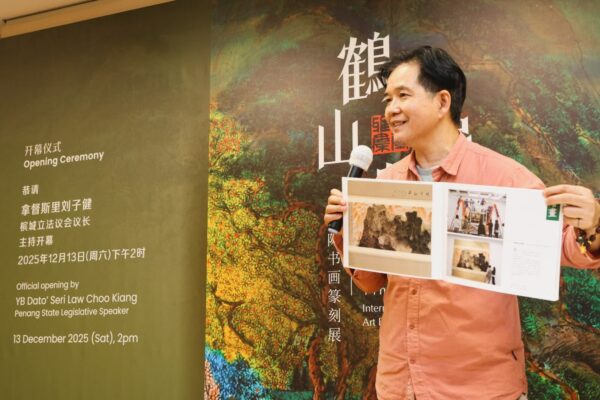
Fung Yat Fung shares his private collection and research findings, utilising both catalogues and physical specimens to guide the audience through a deeper understanding of the historical progression of Chinese painting.The audience maintains a focused presence at the art talk, listening intently to the detailed presentation.
“Wang Duo’s Calligraphic Strategies for Social Exchange” – The Interplay of Art and Interpersonal Relations through Brush and Ink
On 15 December, Dr Wu Guohao, Director and Chief Research Fellow of the Ho Chuang-shih Calligraphy Art Foundation, chaired an art talk titled “Wang Duo’s Calligraphic Strategies for Social Exchange” at the Penang Philomathic Union Sun Yat-Sen Centre. The event attracted nearly a hundred calligraphy enthusiasts, creating a vibrant and engaging atmosphere.
Using Wang Duo’s calligraphic works as a starting point, Dr Wu analysed how the artist transformed calligraphy into a medium for interpersonal and political socialising against the historical backdrop of the late Ming and early Qing dynasties. He pointed out that while Wang Duo served as the Minister of Rites, he was equally renowned for his calligraphy. His works possessed both profound artistic value and practical utility, serving as vital tools for communication and networking.
During the talk, Dr Wu also provided a live demonstration by emulating Wang Duo’s brushwork, recreating the unique spirit and charm of his calligraphic style. This was followed by an interactive session with the audience, allowing participants to appreciate the deep cultural significance behind the art within a relaxed and convivial setting.
Reported by Eng Joo Min, Leang Hui Si, Tan Jin Min and Tan Xin Yee, photographed by Lee Chin Kuan and Shaun Tye Chuen-Han
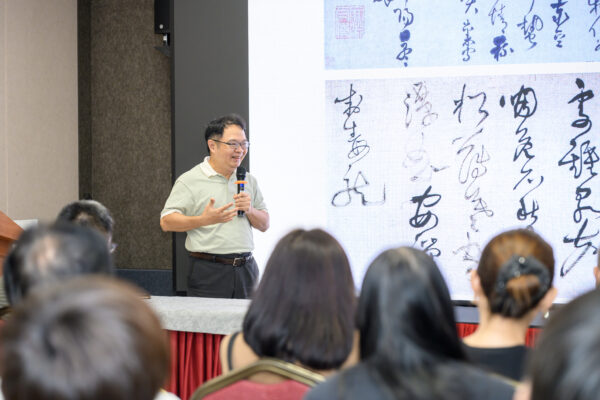
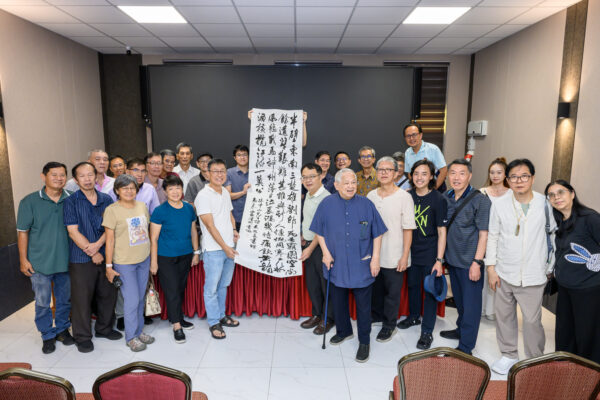
At the art talk, Dr Wu combines calligraphic works with historical records to analyse their cultural significance and underlying social strategies.Following the art talk, Dr Wu poses for a commemorative photo with the audience and displays his calligraphy, leaving everyone with a wonderful memory of the event.
This website places cookies on your computer or device to make the site work better and to help us understand how you use our site. Further use of this site (by clicking, navigating or scrolling) will be considered consent. Please visit our PDPA for more information.
This website uses cookies to improve your experience while you navigate through the website. Out of these, the cookies that are categorized as necessary are stored on your browser as they are essential for the working of basic functionalities of the website. We also use third-party cookies that help us analyze and understand how you use this website. These cookies will be stored in your browser only with your consent. You also have the option to opt-out of these cookies. But opting out of some of these cookies may affect your browsing experience.