4th SGM Headquarters Leaders Conference (Part 1) First SGM Study Academy
The 4th SGM Headquarters Leaders Conference was held from 28 to 30 November 2025 at the SGM Culture Centre. A total of 1,024 region-level and above leaders nationwide gathered for this three-day, two-night conference filled with intensive learning and inspiring sessions.
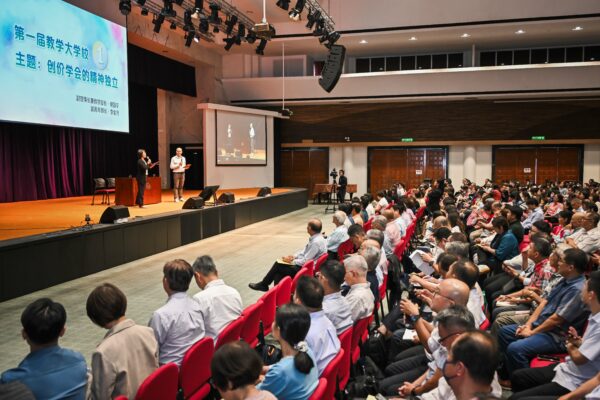
The conference opened on the 28th with the first Study Academy, commemorating the 34th anniversary of the Soka Gakkai’s “Spiritual Independence” on this day. This programme featured three modules exploring the significance of spiritual independence.
Module 1: Spiritual Independence of the Soka Gakkai The Soka Gakkai’s “Casting Off the Transient and Revealing the True”
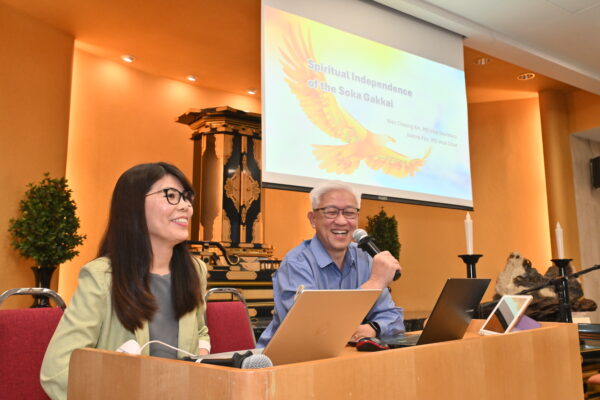
The first session, conducted separately in Chinese and English, revisited the priesthood issue and strengthened participants’ understanding of the contemporary significance of spiritual independence for the kosen-rufu movement. The Chinese session was led by SGM study department leader Chia Kok Peng and youth division vice-leader Lee Kam Yit, while SGM men’s division vice-secretary Dr Wan Cheong Kin and women’s division vice-leader Joanne Foo facilitated the English session.
The speakers shared Nichiren Shoshu’s “Notice of the Excommunication of the Soka Gakkai” in 1991 became a crucial opportunity for the Soka Gakkai to return to the spirit of Nichiren Daishonin and expand worldwide kosen-rufu. Spiritual independence does not mean creating a new system, but returning to the Gohonzon, returning to the Gosho, and returning to the great vow for kosen-rufu.
They emphasised that while the Soka Gakkai is always centred on its mission to save all people, the priesthood was only interested in preserving their authority, thereby deviating from equality and the humanistic spirit of Buddhism.
After achieving spiritual independence, the Soka Gakkai broke away from four major erroneous doctrines of the priesthood and established a humanistic Buddhist perspective rooted in faith. The organisation also strengthened its institutional foundation, such as establishing the Hall of the Great Vow for Kosen-rufu in 2013, revising its rules and regulations from 2014 to 2017, and publishing the Soka Gakkai Liturgy of Gongyo and the Soka Gakkai Charter, all of which laid a solid foundation for the organisation’s development as a world religion.
The speakers encouraged all participants to embrace the conviction “I Am the Soka Gakkai,” and take action to open up a new era of worldwide kosen-rufu.
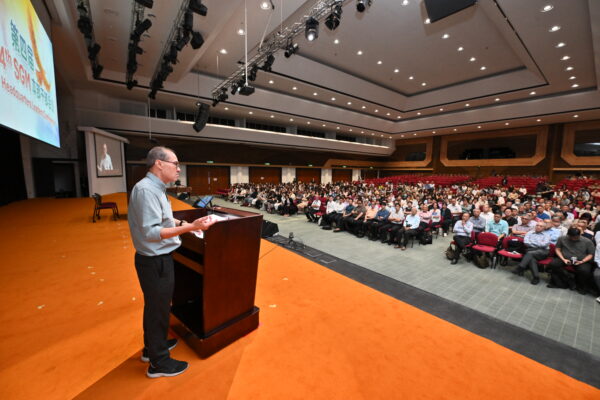
Lee Kam Yit and Chia Kok Peng leading the Chinese session of Module 1 with an engaging question-and-answer format that helped participants grasp the core meaning of the Soka Gakkai’s spiritual independence.The English session, led by Dr Wan Cheong Kin and Joanne Foo, offered clear and insightful explanations that benefited participants greatly.
Module 2: The Eternal Guidelines of the SGM Soka Spirit Movement Only by refuting evil can the truth be revealed!
SGM Soka Spirit department leader Ng Teck Lih began by introducing President Ikeda’s guidance to the First SGM Soka Spirit Seminar (2007):
“The Daishonin’s Buddhism is all about refuting evil and revealing the true! Only by refuting the evil can the truth be revealed! The sure and steady dialogue carried out by each and every one of you is indeed the true way of refuting evil. Only through the action of all of you can the kosen-rufu of Malaysia advance steadfastly!”
He announced that this guidance is the eternal guideline of the SGM Soka Spirit movement.
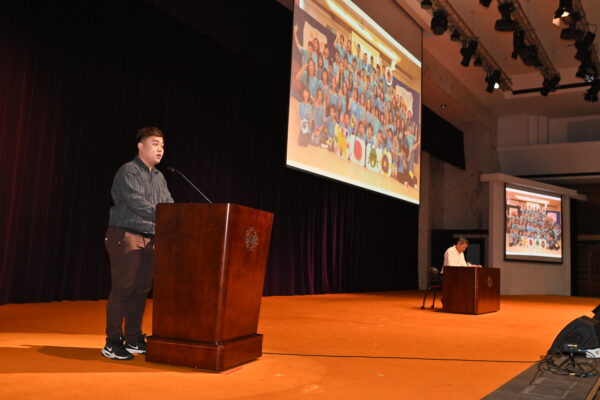
Two leaders shared the outcomes of Soka Spirit efforts in their respective areas. Johor state young men’s division vice-leader Koo Jian Hui shared the case of a women’s division member who left the organisation due to the “Johor Incident.” Later, her son reconnected with youth members and brought the family to visit the Lotus Sutra Exhibition in 2024, which inspired them to return to SGM and walk once more on the path of correct faith.
Selangor region women’s division vice-leader Lee Guat Teng shared how she and her daughter consistently engage in dialogue with members influenced by the Nikken sect. Through earnest prayers to the Gohonzon and warm encouragement, several individuals decided to return to the organisation and transform their circumstances.
Mr Ng then announced the Soka Spirit department’s two activity focuses for 2026: Refute the erroneous and reveal the true, and, expand the forces of good. He also reminded leaders that when members express doubts or there is misinformation circulating, they should quickly conduct home visits and dialogues to prevent people from backsliding.
To expand the forces of good, the Soka Spirit department will focus on strengthening faith and expanding shakubuku efforts. In addition to studying President Ikeda’s guidance, the department will collaborate with the study department to address questions commonly asked by the public, such as why Soka Gakkai members only recite two chapters of the Lotus Sutra (during gongyo).
Ng Teck Lih introducing the Soka Spirit department’s upcoming activity focus.Koo Jian Hui sharing how a leader affected by the “Johor Incident” eventually returned to the organisation and revitalised the practice for oneself and others.
Module 3: The Study System of Soka Gakkai as a World Religion All people are equal; all can attain Buddhahood
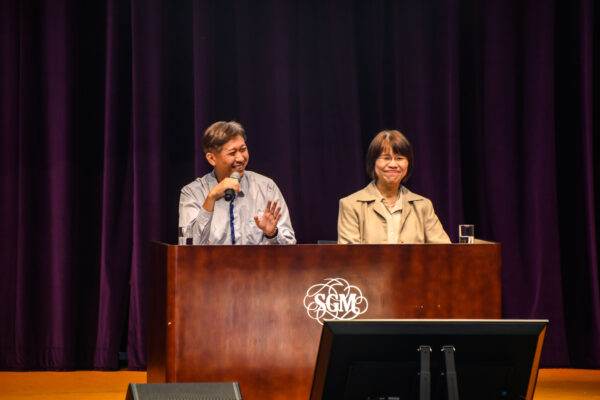
SGM women’s division vice-leader Tan Set Nee and men’s division secretary Loke Weng Cheong explained the qualifications and significance of the Soka Gakkai as a world religion, reminding participants to take pride as Soka Gakkai members and of their mission towards the future.
Mdm Tan highlighted the clear contrast between the Soka Gakkai and other Buddhist schools, noting the Soka Gakkai consistently upholds three key commitments: returning to the Gohonzon, returning to the spirit of Nichiren Daishonin, and returning to the Gosho. She emphasised that studying the Gosho and President Ikeda’s works enables members to master the essence of Nichiren Buddhism. She also reminded participants to use the latest study resources and official platforms, avoiding outdated or unverified materials that may spread incorrect ideas.
Mr Loke then introduced the study department’s activity direction for 2026, calling on leaders to continue promoting study activities. Monthly discussion meeting materials will continue exploring the Gosho and also include topics related to contemporary issues. A study session by the general director was also incorporated into the Headquarters Leaders Conference programme and broadcast nationwide so that more leaders can learn directly from him.
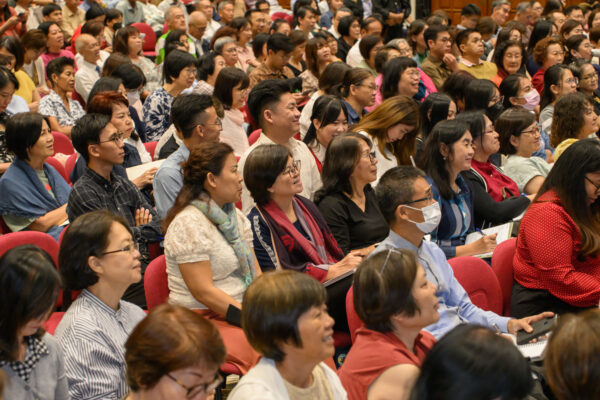
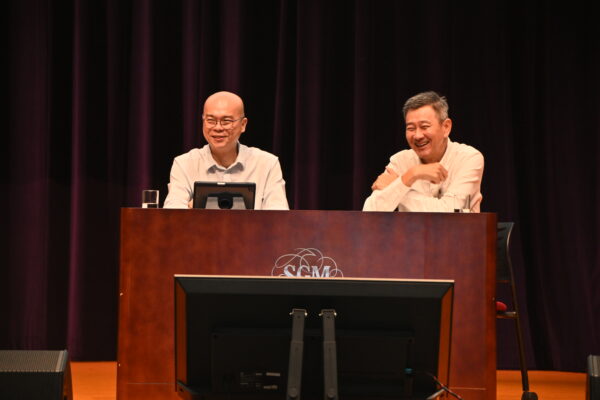
Loke Weng Cheong and Tan Set Nee sharing the significance and mission of the Soka Gakkai as a world religion in a warm and engaging setting.Participants listening attentively and taking notes, strengthening their knowledge of SGM study and Soka Spirit activities.
Question-and-Answer Session and Closing
The question-and-answer session was facilitated by Chia Kok Peng and Ng Teck Lih. Mr Ng explained that the Soka Spirit department protects the organisation and members’ faith, while the study department strengthens faith through Buddhist study. Both functions are inseparable in the mission of refuting evil and revealing the truth. Mr Chia illustrated this using an example of an external group disrupting SGM members’ faith, and how leaders steered them back towards faith through explanations and dialogues.
Study department member Khoo Koon Hoe reminded participants that in the age of artificial intelligence (AI), leaders should use it with caution and avoid using AI-generated material as study content. He encouraged the use of official study resources, including the SGI library (Chinese), the Nichiren Buddhism Library, and Cosmic Online.
In his summary, SGM vice-general director Johnny Ng revisited the priesthood’s excommunication on 28 November 1991, stressing that it was not a loss but a pivotal moment that freed the organisation from authoritarianism. He explained that the priesthood, unable to recognise the Buddhahood inherent in ordinary people, fell into fundamental darkness and responded with jealousy and hostility as the Soka Gakkai’s achievements expanded, even formulating “Operation C” to control believers. These actions accelerated the Soka Gakkai’s spiritual independence.
He noted that now is the era of youth. Initiatives such as the 8,000-youth shakubuku goal, youth dialogue movement and The New Human Revolution Generation Morning Sharing are igniting waves of hope across Malaysia. Only by allowing youth to stand at the forefront can the organisation open a victorious new age of kosen-rufu. He called on all leaders nationwide to embody the spirit to keep striving with our mentor in our hearts, inherit President Ikeda’s spirit of “refuting the erroneous and revealing the true” and human revolution, and advance towards 2030 with the courage of a lion king.
Jointly reported by Goh Lim Erng and Eng Joo Min, photographed by Lum Heng and Jeffery Lum
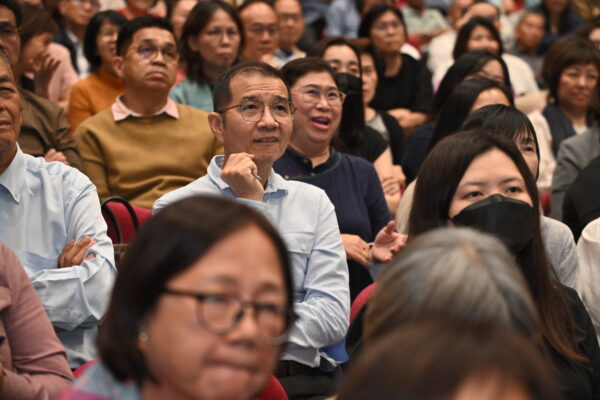
Chia Kok Peng and Ng Teck Lih offering clear explanations on topics related to Buddhist study and Soka Spirit.SGM vice-general director Johnny Ng encouraging leaders to recognise the enduring nature of the struggle between good and evil, uphold Buddhist study and learn from history.Participants listening earnestly to the speakers’ explanation of the meaning of spiritual independence, contributing to protecting the organisation.
This website places cookies on your computer or device to make the site work better and to help us understand how you use our site. Further use of this site (by clicking, navigating or scrolling) will be considered consent. Please visit our PDPA for more information.
This website uses cookies to improve your experience while you navigate through the website. Out of these, the cookies that are categorized as necessary are stored on your browser as they are essential for the working of basic functionalities of the website. We also use third-party cookies that help us analyze and understand how you use this website. These cookies will be stored in your browser only with your consent. You also have the option to opt-out of these cookies. But opting out of some of these cookies may affect your browsing experience.